diagram a cell with 4 chromosomes going through meiosis
7.5: Amphimixis: Meiosis and gametogenesis
- Paginate ID
- 16757

The family photo in Figure \(\PageIndex{1}\) illustrates an heavy point. Children in a family resemble their parents and each other, but the children are never exactly the same unless they are monovular Twins. Each of the children in the photo inherited a single combination of traits from the parents. In this construct, you will learn how this happens. It all begins with sex — sexual breeding, that is.

Sexual Reproduction
Why do you look similar to your parents, simply not identical? First, IT is because you have two parents. Second, information technology is because of sexual reproduction. Whereas asexual replica produces genetically identical clones, sexual reproduction produces genetically diverse individuals. Amphimixis is the creation of a new organism by combination the genetic material of two organisms. As both parents contribute half of the new being's genetic material, the offspring bequeath have traits of some parents, but will not be incisively like-minded either parent.
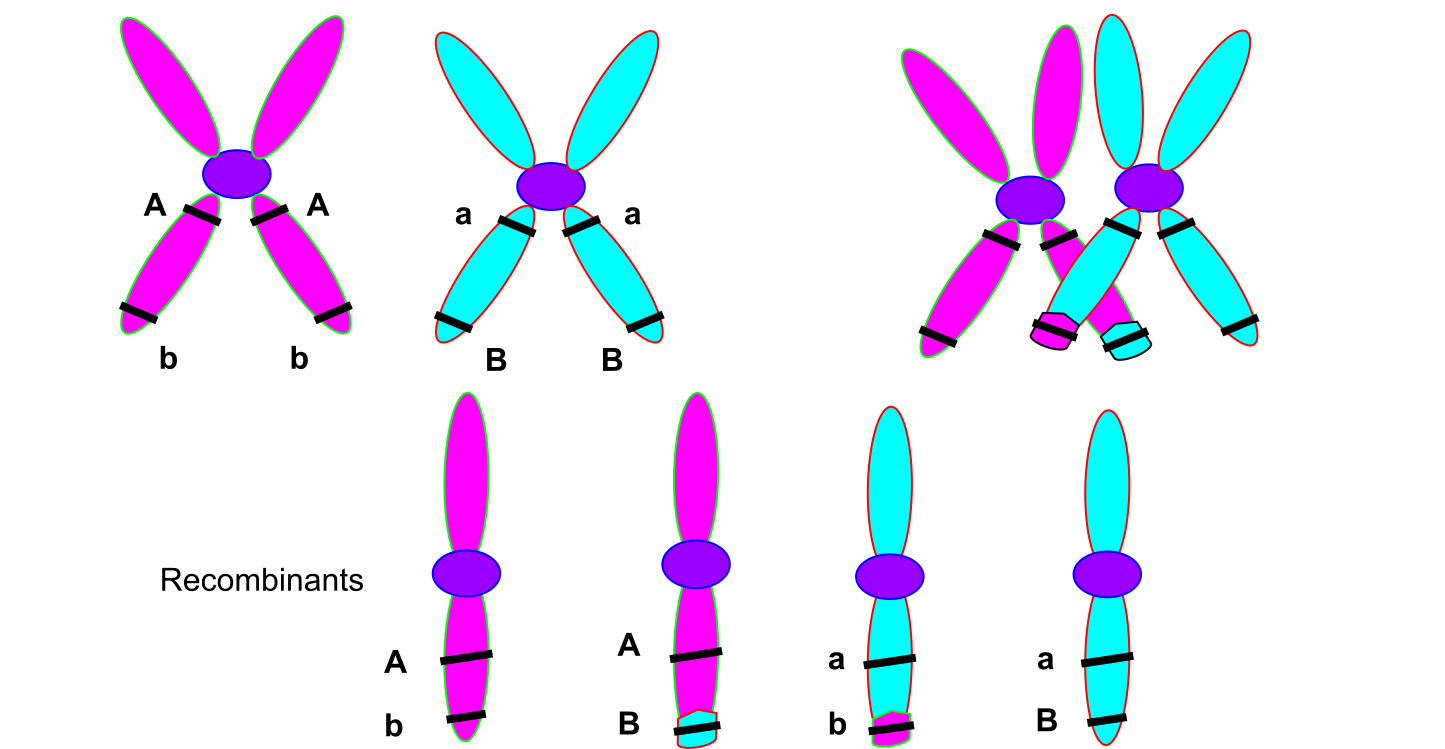
Organisms that reproduce sexually by joining gametes, a swear out known as fertilization, must have a mechanism to produce monoploid gametes. This mechanism is reduction division, a type of cellular division that halves the number of chromosomes. During meiosis, the pairs of chromosomes class and segregate randomly to produce gametes with one chromosome from each pair. Meiosis involves two nuclear and cell divisions without interphase in 'tween, start with one diploid cell and generating four haploid cells. Each division, named meiosis I and litotes II, has four stages: prophase, metaphase, anaphase, and telophase. These stages are similar to those of mitosis, but there are distinct and important differences.
Prior to miosis, the cell's Desoxyribonucleic acid is replicated, generating chromosomes with two sister chromatids. A human cell prior to meiosis will get 46 chromosomes, 22 pairs of homologous autosomes, and 1 pair of sex chromosomes. Homologous chromosomes (Figure \(\PageIndex{2}\)), or homologs, are similar in size, determine, and genetic content; they contain the selfsame genes, though they may have different alleles of those genes. The genes/alleles are at the same loci on homologous chromosomes. You inherit one chromosome of each couple of homologs from your mother and the new one from your father. Amphimixis is the primary method of reproduction for the vast majority of multicellular organisms, including almost complete animals and plants. Dressing joins two monoploid gametes into a diploid zygote, the first cell of a new organism. The fertilized ovum enters G1 of the first cell cycle, and the organism begins to grow and develop finished mitosis and cell division.
Meiosis

The appendage that produces monoploid gametes is called meiosis. Meiosis is a type of cellular division in which the enumerate of chromosomes is belittled by half. It occurs only in certain special cells of an being. In mammals, Meiosis occurs only in gamete producing cells within the gonads. During meiosis, homologic (paired) chromosomes separate, and haploid cells form that have only one chromosome from each pair. Figure \(\PageIndex{3}\) gives an overview of meiosis.
As you keister see from the meiosis diagram, two cell divisions occur during the overall process, so a total of four haploid cells are produced. The two cell divisions are titled meiosis I and litotes II. Reduction division I begins after DNA replicates during interphase. Meiosis 2 follows reduction division I without DNA replicating again. Both meiosis I and meiosis II occur in four phases, called prophase, metaphase, anaphase, and telophase. You may recognize these four phases from mitosis, the division of the nucleus that takes aim during subprogram cellular phone division of eucaryotic cells.

Meiosis I
- Prophase I: The nuclear gasbag begins to smash down, and the chromosomes condense. Centrioles start moving to diametric poles of the cell, and a spindle begins to form. Importantly, homologous chromosomes pair up, which is unique to prophase I. In prophase of mitosis and meiosis II, homological chromosomes ut not form pairs in that way. During prophase I, crossing-over occurs. The significance of crossing-over is discussed in the next section titled variations.
- Metaphase I: Spindle fibers attach to the mated homologous chromosomes. The paired chromosomes line up along the equator of the cell. This occurs entirely in metaphase I. In metaphase of mitosis and meiosis Cardinal, information technology is sister chromatids that line upbound on the equator of the cell.
- Anaphase I: Spindle fibers shorten, and the chromosomes of each homologous pair start to separate from each other. One chromosome of apiece pair moves toward one pole of the cell, and the other chromosome moves toward the opposite pole.
- Telophase I and Cytokinesis: The spindle breaks down, and new nuclear membranes form. The cytoplasm of the cellphone divides, and two monoploid girl cells result. The daughter cells each have a ergodic variety of chromosomes, with one from each homologous pair. Both daughter cells go on to meiosis Cardinal.
Meiosis II
- Prophase II: The nuclear envelope breaks down and the spindle begins to form in from each one haploidic daughter electric cell from meiosis I. The centrioles also outset to separate.
- Metaphase II: Spindle fibers queue the sister chromatids of from each one chromosome along the equator of the cell.
- Anaphase II: Sister chromatids separate and move to opposite poles.
- Telophase II and Cytokinesis: The spindle breaks down, and new nuclear membranes form. The cytoplasm of each cell divides, and four monoploid cells result. Each cell has a unique combination of chromosomes.
Gametogenesis
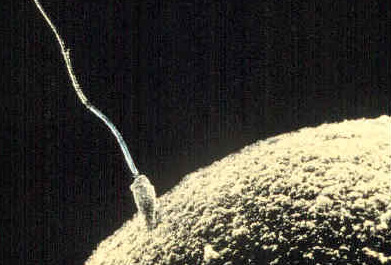
At the end of meiosis, four monoploid cells have been produced, but the cells are not yet gametes. The cells pauperism to develop earlier they become fully fledged gametes capable of fertilization. The development of diploid cells into gametes is called gametogenesis. It differs betwixt males and females.
- A gamete produced aside a manly is called a sperm, and the process that produces a mature sperm is called spermatogenesis. During this cognitive process, a sperm cell grows a tail and gains the ability to "float," care the man spermatozoon cell shown in the figure below.
- A gamete produced by a female is titled an ballock, and the process that produces a mature egg is called oogenesis. Vindicatory one egg is produced from the four haploid cells that result from litotes. The single egg is a very large cubicle, as you backside see from the human egg likewise shown in Figure \(\PageIndex{5}\).
Spermatogenesis
Spermatogenesis occurs in the wall of the seminiferous tubules, with stem cells at the periphery of the tube and the spermatozoa at the lumen of the tube. Immediately low the abridgment of the tubule are diploid, undifferentiated cells. These staunch cells, called spermatogonia (singular: spermatagonium), pass over mitosis with one offspring going on to differentiate into a sperm cell cell, while the other gives rise to the next generation of sperm.
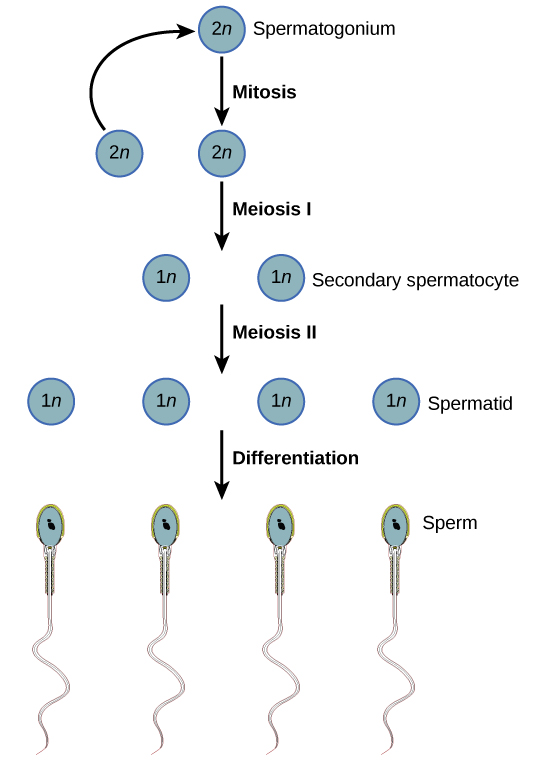
Figure out \(\PageIndex{6}\): Spermatogenesis During spermatogenesis, four sperm result from each original spermatocyte, which divides into 2 haploidic secondary spermatocytes; these cells leave go through a intermediate cellular division division to produce four spermatids.
Miosis begins with a cell named a primary spermatocyte. At the end of the first meiotic division, a haploid cell is produced called a subsidiary spermatocyte. This haploid cellular telephone essential go finished other meiotic cell division. The cell produced at the end of meiosis is called a spermatid. When it reaches the lumen of the tubule and grows a flagellum (or "tail"), it is called a spermatozoon cell. Four sperm result from each primary spermatocyte that goes through meiosis.
Stem cells are deposited during pregnancy and are nowadays at birth finished the source of adolescence but in an supine state. During adolescence, gonadotropic hormones from the front pituitary cause the activation of these cells and the production of viable sperm. This continues into old years.
Oogenesis
Oogenesis occurs in the outmost layers of the ovaries. As with sperm production, oogenesis starts with a germ cellphone, called an oogonium (plural: oogonia), just this jail cell undergoes mitosis to addition in keep down, eventually subsequent in up to one to two 1000000 cells in the fertilized egg.

The cell starting meiosis is named a primary oocyte. This prison cell will begin the first meiotic division, only be in remission in its pass on in the starting time prophase stage. At the prison term of parentage, all future eggs are in the prophase stage. At adolescence, anterior pituitary hormones cause the development of a count of follicles in an ovary. This results in the primary oocyte finishing the first cell division division. The prison cell divides unequally, with just about of the cellular material and organelles going to extraordinary cellular phone, called a secondary oocyte, and only one set of chromosomes and a flyspeck amount of cytol going to the otherwise cubicle. This 2nd cell is called a polar body and usually dies. A lower-ranking meiotic arrest occurs, this time at the metaphase II stage. At ovulation, this secondary oocyte will be released and travel toward the uterus through the oviduct. If the secondary oocyte is fertilized, the cell continues through the meiosis Cardinal, completing meiosis, producing a second polar body and a embryo containing all 46 chromosomes of a human being, half of them coming from the sperm.
Review
- Explain how sexual reproduction occurs at the cellular level.
- Summarize what happens during meiosis.
- Compare and contrast gametogenesis in males and females.
- Explicate mechanisms that increase genetic variation in offspring produced by amphimixis.
- Why act up gametes need to comprise haploidic? What would happen to the chromosome number after fertilization if they were diploid?
- Describe one difference between prophase I of meiosis and prophase of mitosis.
- Do altogether of the chromosomes that you got from your mother get in one of your gametes? Why or why not?
- True or False . Crossing-over is the exchange of biological science material between Sister chromatids.
- True or False . Anthropomorphous sperms are monoploid.
- True or False . Sister chromatids separate from each other during meiosis I.
- How many cells are produced after a single cell goes through meiosis?
- Which stage of meiosis (prophase I or II; metaphase I or Deuce; anaphase I operating theater Two; telophase I operating theater II) best fits the descriptions below? Choose only combined for each description.
- Pairs of homologous chromosomes bank line up along the equator of the cellular phone
- Sister chromatids severalise
- Homologous chromosomes separate from to each one different
Explore Sir Thomas More
diagram a cell with 4 chromosomes going through meiosis
Source: https://bio.libretexts.org/Bookshelves/Human_Biology/Book:_Human_Biology_%28Wakim_and_Grewal%29/07:_Cell_Reproduction/7.5:_Sexual_Reproduction:_Meiosis_and_gametogenesis

Posting Komentar untuk "diagram a cell with 4 chromosomes going through meiosis"